Madama Butterfly – Giacomo Puccini
Running time: 3 hours 20 minutes, including two intervals
Language: Italian
Surtitle: Hungarian, English, Italian
In co-operation with the Grand Théâtre de Genève
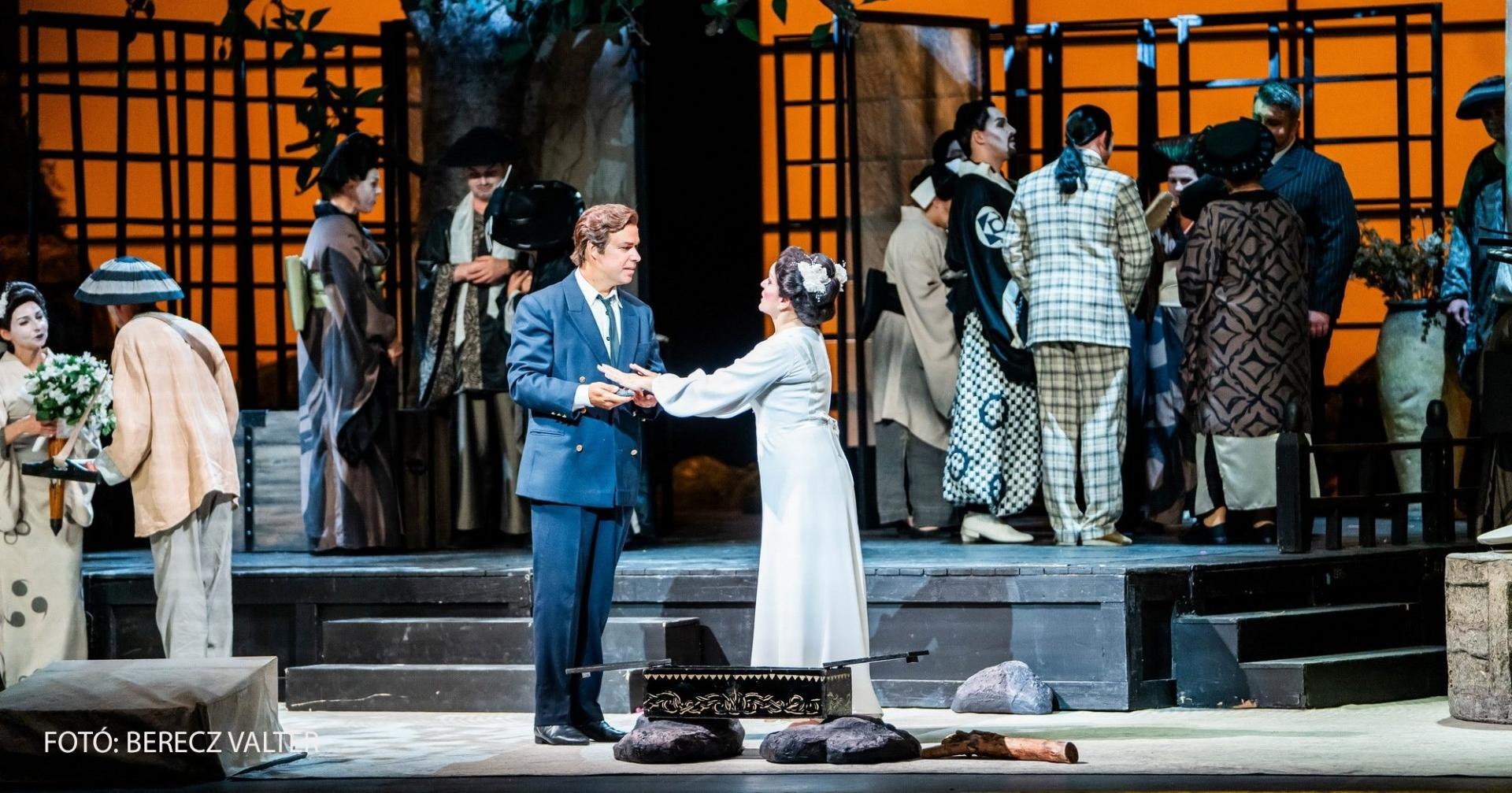
One of the absolute “hits” of the opera repertoire, Giacomo Puccini’s Madama Butterfly, is well-known to every opera lover; its tragic story has brought tears to millions of eyes in the century since its premiere. Countless creators around the world have staged the work in countless interpretations, as the world has changed greatly, and with it, so has the way the piece is perceived. The time has come for the OPERA’s former, traditional production to be replaced by a new one, whose female-centred perspective adds new layers of meaning. For if we think about it more deeply, everything we see is merely a tiny fragment of the whole, and each piece of the puzzle can only gain meaning together with the others. And what would happen if we were to view this story through the eyes of a boy who happens to be an unplanned child of a young Japanese geisha and an American sailor, observing events from a time that no longer belongs to his passionate, young parents? Born in Prague, trained in vocal art in Switzerland and later in directing in Germany, and maintaining a close working relationship with the also well-known Calixto Bieito, Barbora Horáková offers an innovative interpretation: a dual narrative spanning generations and continents, accompanied by the powerful visual world of Armenian-born American photo and video artist Diana Markosian. Following the spectacular Prokofiev opera War and Peace, this new collaboration between the OPERA and the Grand Théâtre de Genève examines traditions, passions, and their impact across generations. The production arrives in Budapest following its 2026 Swiss premiere.
Age restriction: The performance is not recommended for children under 14 years of age.
Synopsis
Act I
On a hill overlooking Nagasaki harbour, U. S. Navy Lieutenant Benjamin Franklin Pinkerton inspects a Japanese house with Goro, a sharp local marriage broker who has arranged for him to have it when he marries Cio-Cio san. Pinkerton meets Suzuki, who has been hired as the bride's chambermaid. Consul Sharpless is the first to arrive for the ceremony. The carefree Pinkerton explains to him that he has signed a 999-year marriage contract, which he can cancel any time he likes. Sharpless feels concern for the Japanese girl, who may take her vows more seriously. The bridal party is approaching, headed by Cio-Cio san. She greets Pinkerton and the consul and she tells the latter about her background: the family having lost its money, she became a geisha, which she points out is a respectable profession. She turns out to be fifteen years old. When Pinkerton asks Butterfly what she is carrying in her full sleeves, she shows toilet articles, then a sheathed knife, which she does not want to discuss. Goro explains that her father committed hara-kiri on orders from the emperor. The girl tells Pinkerton she visited the consulate to see about adopting his religion. The Commissioner reads the marriage contract, which the parties sign. The party is interrupted by an uncle of Cio-Cio san's, a bonze, who has found out about her conversion and stirs up the others to denounce her. Pinkerton comforts Cio-Cio san, who calls Suzuki to help her change into her bridal nightgown. As evening falls, Pinkerton speaks lovingly to his bride, and they embrace before entering the house.
Act II
Three years later in the same house Butterfly is waiting patiently for her husband's return. Suzuki doubts that Pinkerton will come back as he had promised, 'when the robins build their nests'. Goro appears with Sharpless, who tells Butterfly that Pinkerton has written him, asking him to seek her out. Butterfly is overjoyed. Goro now introduces a suitor, Prince Yamadori, whom she haughtily informs that she is already married. Goro, Yamadori and Sharpless share the information that Pinkerton's ship will soon arrive but he does not want to see Butterfly. Sharpless interrupts reading out the letter to ask Butterfly what she would do if her husband never returned. She could go back to be a geisha, she says - or, better, die. Sharpless advises her to marry Yamadori, at which the indignant Butterfly introduces her son, saying that Pinkerton will surely come when he knows about him. Sharpless leaves without delivering his entire message. A cannon shot is heard; Butterfly recognizes the ship in the harbour as Pinkerton's. Beside herself with joy, she makes Suzuki join her in gathering flowers and strewing them around the house. Once more she has Suzuki bring her bridal gown. The two women and the child sit watching for Pinkerton's return.
Act III
The exhausted Butterfly goes to her room to sleep for a while with Suzuki's promise to wake her when Pinkerton comes. Scarcely has she gone when Pinkerton arrives accompanied by Sharpless, telling Suzuki not to wake Butterfly Suzuki spots a woman in the garden. Pinkerton's 'real American wife'. The two men want Suzuki's help in persuading Butterfly to relinquish the child. Distressed by the house full of memories, Pinkerton asks Sharpless to do whatever is necessary for Butterfly and leaves. His wife Kate comes in with Suzuki. Butterfly returns wondering where Pinkerton may be, quickly guessing that Kate is his wife. She says Pinkerton can take his son if he will come for him in person. When the visitors have gone, she takes her father's dagger and is about to stab herself when the child runs in unexpectedly. She embraces him in an impassioned farewell and sends him to play with an American flag. She kills herself with the knife behind a screen. Dragging herself back to embrace her son, she dies as the distraught Pinkerton, calling her name, returns with Sharpless.
 en
en 
 de
de it
it fr
fr es
es ru
ru jp
jp ro
ro







 Hungarian State Opera
 Sat 12 Jun 2027 - Sun 27 Jun 2027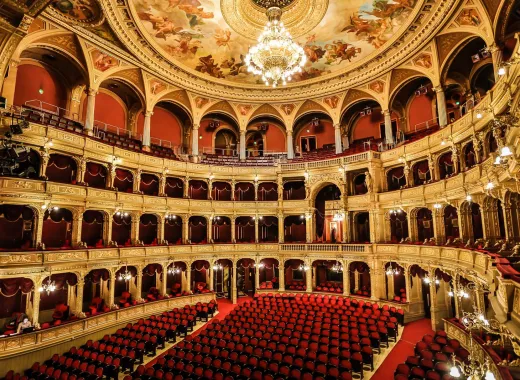



 RM EUROPA TICKET GmbH
 Call now
 Book now