
 EN
EN DE
DE IT
IT FR
FR ES
ES RU
RU JP
JP RO
RO
Passion
Order tickets
 January 2028 January 2028 | ||||||
|---|---|---|---|---|---|---|
Mo | Tu | We | Th | Fr | Sa | Su |
Passion | Máté Bella – András Almási-Tóth
Contemporary | Opera | Oratorio
Running time: 2 hours 30 minutes including one interval
Language: Hungarian
Surtitle: Hungarian, English
Following his one-act opera Spring Awakening, in collaboration with the Franz Liszt Academy of Music, and the orchestration of L’incoronazione di Poppea premiered at the Eiffel Art Studios, the Hungarian State Opera now presents a work by composer Máté Bella at the Opera House for the first time. The Erkel Ferenc Prize and Béla Bartók – Ditta Pásztory Prize recipient composer has already left his mark in a wide range of musical styles, from chamber music and orchestral works to incidental music and pop music; now, turning once again toward the classical music stage, he has created an operaoratorio that explores the Passion story of Christ. One of the work’s most distinctive dramaturgical features of the composition, written for the scholarship competition of the Hungarian Academy of Arts, is its reverse narrative structure: the story unfolds backward, from the death of Jesus to the Last Supper. This treatment of time opens up a new perspective and places the dramatic climax not in the crucifixion itself, but in the moment when Jesus chooses to set out on his path on Maundy Thursday. The world premiere of the work is staged by András Almási-Tóth, the OPERA’s artistic director and the librettist of the piece. The libretto shifts the focus away from the physical brutality of the Passion narrative and explores the human and spiritual process instead through which Jesus consciously accepts and fulfils his destiny. The aim of the authors is to reinterpret the opera-oratorio genre and bring it closer to today’s Y and Z generations, without sacrificing musical or conceptual depth. This work is not merely a performance, but a dialogue about faith, choice, and responsibility, and about what this two-thousand-year-old story might mean for a contemporary European audience today.
This performance uses the Parsifal set designed by Sebastian Hannak.
Parental guidance: The performance is not recommended for children under 12 years of age.
Program and cast
Conductor: Adam Cser
Jesus: Botond Pál (opera studio)
Pilate: Zsolt Haja
Caiaphas: Károly Szemerédy
Peter: Gergely Ujvári
Judas: Artúr Szeleczki
1st bandit: Gergely Halász (opera studio)
2nd bandit: Attila Dobák
Maid: Lilla Horti
Featuring the Hungarian State Opera Orchestra and Chorus
Director: András Almási-Tóth
Costume designer: Lili Izsák
Movement director: Eszter Lázár
Chorus director: Gábor Csiki
Composer: Máté Bella
Librettist: András Almási-Tóth
Hungarian State Opera
STANDING ROOM TICKETS - INFORMATION IN CASE OF A FULL HOUSE!
If all the seats are sold out for the selected time, but you still want to see the production on that day, 84 of the extremely affordable standing seats will be sold at the theatre, 2 hours before the start of the performance, with which you can visit the gallery on the 3rd floor. Tickets can be purchased at the ticket office of the Budapest Opera House. We would like to draw your attention to the fact that the stage can only be seen to a limited extent from the standing places and the side seats, but at the same time, following the performance is also supported by television broadcasting on the spot.
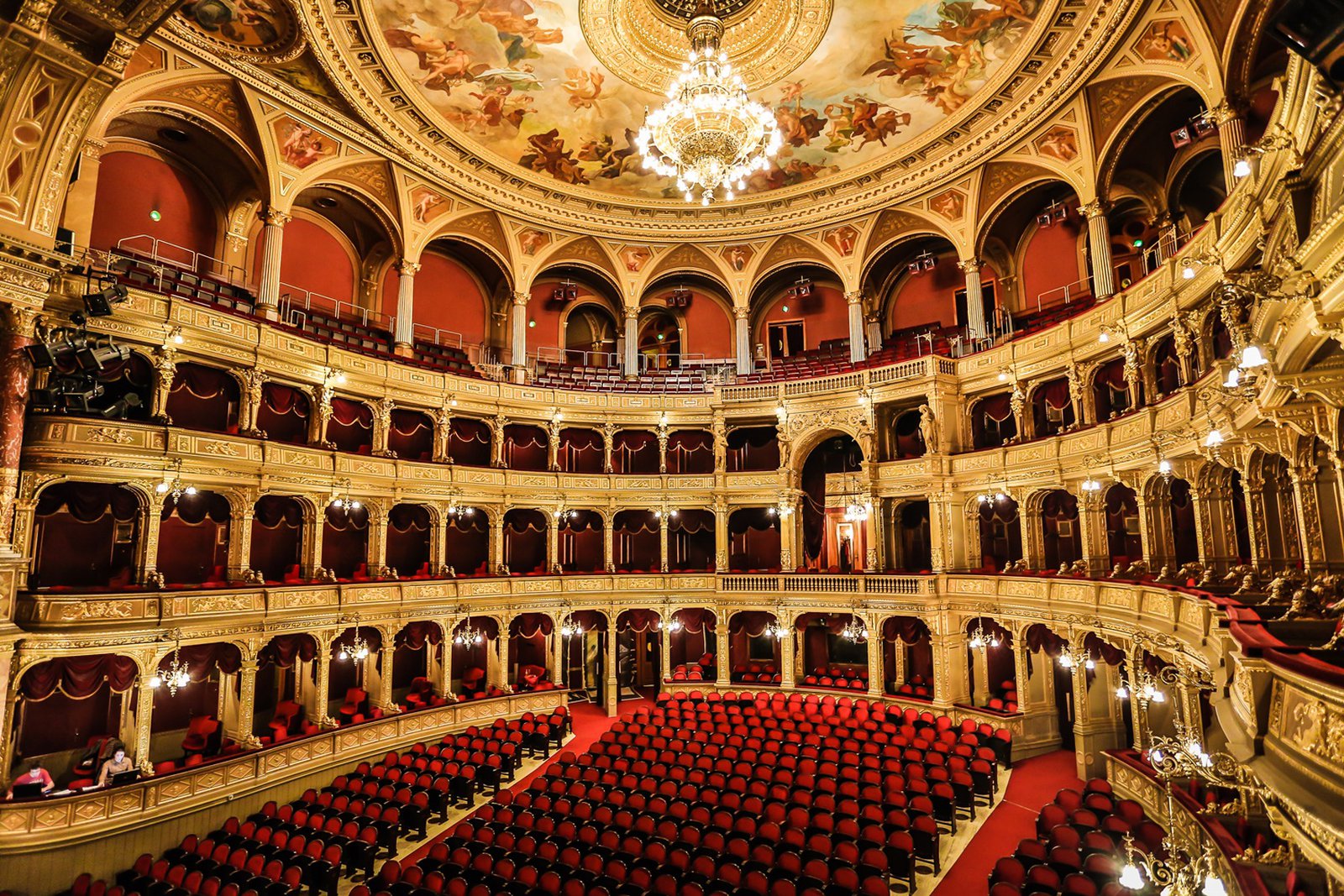
The Opera House is not only one of the most significant art relic of Budapest, but the symbol of the Hungarian operatic tradition of more than three hundred years as well. The long-awaited moment in Hungarian opera life arrived on September 27, 1884, when, in the presence of Franz Joseph I. the Opera House was opened amid great pomp and ceremony. The event, however, erupted into a small scandal - the curious crowd broke into the entrance hall and overran the security guards in order to catch a glimpse of the splendid Palace on Sugar út. Designed by Mikós Ybl, a major figure of 19th century Hungarian architecture, the construction lived up to the highest expectations. Ornamentation included paintings and sculptures by leading figures of Hungarian art of the time: Károly Lotz, Bertalan Székely, Mór Than and Alajos Stróbl. The great bronze chandelier from Mainz and the stage machinery moda by the Asphaleia company of Vienna were both considered as cutting-edge technology at that time.
Many important artists were guests here including Gustav Mahler, the composer who was director in Budapest from 1887 to 1891. He founded the international prestige of the institution, performing Wagner operas as well as Magcagni’ Cavalleria Rusticana. The Hungarian State Opera has always maintained high professional standards, inviting international stars like Renée Fleming, Cecilia Bartoli, Monserrat Caballé, Placido Domingo, Luciano Pavarotti, José Cura, Thomas Hampson and Juan Diego Flórez to perform on its stage. The Hungarian cast include outstanding and renowed artists like Éva Marton, Ilona Tokody, Andrea Rost, Dénes Gulyás, Attila Fekete and Gábor Bretz.
©

Related events