
 EN
EN DE
DE IT
IT FR
FR ES
ES RU
RU JP
JP RO
RO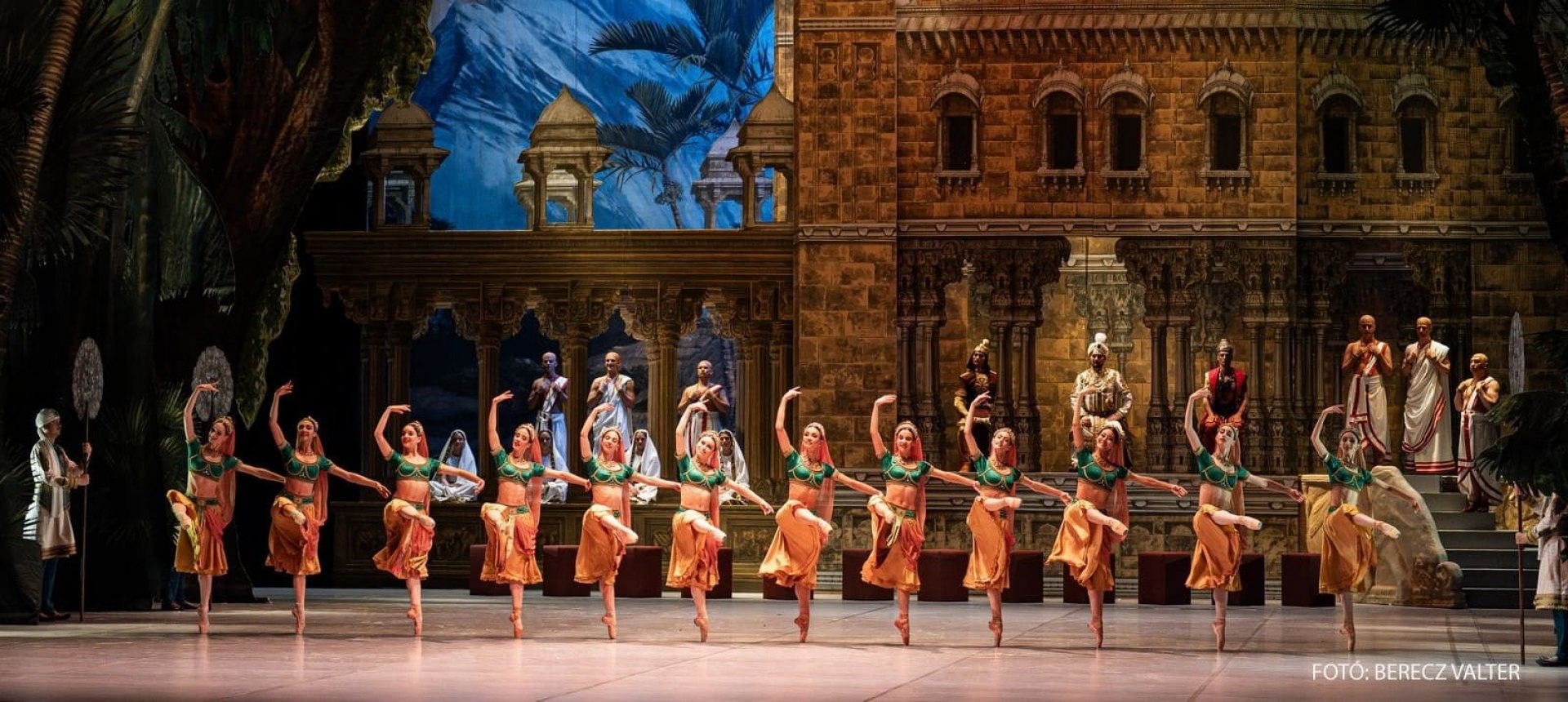
© Berecz Valter
La Bayadere
Order tickets
 September 2027 September 2027 | ||||||
|---|---|---|---|---|---|---|
Mo | Tu | We | Th | Fr | Sa | Su |
La Bayadère – Marius Petipa – Albert Mirzoyan / Ludwig Minkus
Classical ballet
Running time: 3 hours 21 minutes including two intervals
Marius Petipa’s choreography takes the audience to legendary India to witness the tragic love story between a temple dancer and a noble warrior. La Bayadère is an excellent example of the classical ballet tradition, but the new Hungarian National Balett production will prove to be a real treat. The records of the original 1877 choreography are incomplete, the fourth act of the ballet is lost. Thanks to the efforts of ballet master / choreographer Albert Mirzoyan, with the reconstruction of the missing parts, the complete story can be enjoyed again.
Parental guidance - The performance is not recommended for children under 12 years of age.
Production warnings - Strong flashing lights are used in some scenes of the performance which could disturb those with photosensitivity.
Synopsis
Act I
Scene 1
A group of young warriors led by Solor are hunting tigers. Before venturing deep into the forest, Solor orders the fakir Magdaveya to take his message to the bayadere Nikiya that he would be waiting for her outside the temple. The priests led by the High Brahmin march out from the temple to participate in the Festival of Fire. The fakirs and the temple dancers or bayaderes are performing a holy dance – the beautiful Nikiya is among them. After the ceremony the High Brahmin, forgetting his dignity and his oath as a priest, confesses his love to Nikiya. He promises her all the treasures of India, but she rejects him. The bayaderes offer the fakirs water from the holy well. Magdaveya secretly passes Solor’s message to Nikiya, which fills her heart with happiness. Night descends, and Nikiya obeys the call of love. Although the fakir guards their secret rendezvous, the High Brahmin can overhear the lovers’ conversation. Solor suggests Nikiya eloping together. The girl agrees but asks Solor to swear by the holy fire that he would be faithful to her forever. The High Brahmin prepares for his revenge and turns to the gods for punishment.
Scene 2
The Rajah Dugmanta tells his daughter, Gamzatti that she would soon meet her fiance. Solor arrives at the palace; the Rajah introduces his beautiful daughter to him, and announces their engagement. Solor is impressed by Gamzatti’s beauty and cannot refuse to marry her in spite of her oath to Nikiya. Nikiya is summoned to the palace to Gamzatti’s betrothal celebration. The High Brahmin appears too, and wants to inform the Rajah about Solor’s secret vow. Dugmata sends away everybody, feeling that the priest’s visit is related to the oncoming wedding. Gamzatti overhears the conversation between the Brahmin and his father, and thus learns that Solor is in love with Nikiya. Although Dugmanta loses his temper, he does not change his intention that his daughter should marry Solor. The Rajah decides that the bayadere cannot be an obstacle to the marriage, so she has to die. The Brahmin expected to dispose of his rival with his intrigue, but now he is shocked to hear the Rajah’s cruel decision. Nikiya returns, and so Gamzatti can meet her rival, who is really beautiful. The Rajah’s daughter boasts of her approaching wedding and invites the bayadere to dance at the event, and deliberately shows her Solor’s picture. Nikiya is exasperated, since Solor swore eternal faithfulness to her at the temple. Gamzatti demands Nikiya to give up Solor, but the bayadere is rather ready to die. The Rajah’s daughter offers jewellery and richness to her, but she rejects the proposal indignantly, as she would not leave her love for any treasure. During the heated debate Nikiya attacks Gamzatti with a dagger, but the servant Aiya steps in between them, and the bayadere runs away desperately. Gamzatti realizes that she can only get Solor if Nikiya dies.
Act II
A spectacular celebration is going on in the garden of the Rajah’s palace on the occasion of Solor’s and Gamzatti’s wedding. Nikiya has also been invited to delight the guests with her holy dance. The bayadere must not reveal her sorrow, but she cannot help glancing at her beloved Solor again and again. Aiya hands over a basket of flowers to Nikiya in the name of the Rajah, but she has hidden a snake in the basket on Gamzatti’s order. The bayadere continues her dance even more joyfully, believing that it was Solor who has sent her the present. As she is holding the basket, the snake bites her. The Brahmin offers her an antidote to the poison in exchange of her love, but the bayadere remains faithful to her love, and chooses death instead. Solor desperately collapses on the dead body of his beloved.
Act III
Scene 1
The inconsolable Solor is suffering from remorse. He orders Magdaveya to bring some opium to dispel his torturing thoughts.
Scene 2
After Solor falls in a deep dream, shades emerge from the darkness. They descend from the peaks of the mountains in a long line, and Nikiya is among them too.
Scene 3
The warrior awakens from his dream. The rajah arrives accompanied by Toloragva. He warns Solor that the time has come, the wedding is approaching. The young man receives his words reluctantly, yet he is ready to fulfil the promise he made to Dugmanta.
Scene 4
At the wedding ceremony, the guests greet the young couple with dance. One of them hands a basket full of flowers to Gamzatti, who immediately throws it away. It reminds her of the basket that once hid the venomous snake that caused the death of the bayadère. Solor envisions Nikiya, but the rajah pulls him back to reality. The union is soon to be sealed. The great Brahmin blesses the couple, and everyone enters the temple. But happiness cannot follow Gamzatti and Solor on their path. The wrath of the god Vishnu strikes down, destroying the temple. In death, Solor and the bayadère are reunited, their love is stronger than anything else, now in eternity.
Program and cast
Conductor: David Coleman, Peter Dobszay
Nikiya, a bayadère: Tatyjana Melnyik, Maria Yakovleva, Maria Beck, Ellina Pohodnih, Soobin Lee
Solor, rich warrior: Motomi Kiyota, András Rónai, Gergő Ármin Balázsi, Louis Scrivener, Boris Zhurilov
Gamzatti, the daughter of the Rajah: Yuki Wakabayashi, Claudia García Carriera, Anastasiia Nuikina, Elena Sharipova
Featuring the Hungarian National Ballet, the Hungarian State Opera Orchestra and the Hungarian National Ballet Institute.
Choreographer: Marius Petipa, Albert Mirzoyan
Set designer: István Rózsa
Costume designer: Nóra Rományi
Lighting designer: Tamás Pillinger
Company répétiteur: Cristina Balaban, Stanislav Beliaevskii, Anastasia Dunets, James Forbat, István Kohári, Gergely Leblanc, Albert Mirzoyan, Ildikó Pongor, Tamás Solymosi, Győrgy Szirb
Répétiteur of the Hungarian National Ballet Institute: Dace Radina, Nataliia Yakushkina
Music of reconstructed scenes compiled and arranged by György Lázár
Composer: Ludwig Minkus
Librettist: Marius Petipa, Szergej Hugyekov
Hungarian State Opera
STANDING ROOM TICKETS - INFORMATION IN CASE OF A FULL HOUSE!
If all the seats are sold out for the selected time, but you still want to see the production on that day, 84 of the extremely affordable standing seats will be sold at the theatre, 2 hours before the start of the performance, with which you can visit the gallery on the 3rd floor. Tickets can be purchased at the ticket office of the Budapest Opera House. We would like to draw your attention to the fact that the stage can only be seen to a limited extent from the standing places and the side seats, but at the same time, following the performance is also supported by television broadcasting on the spot.
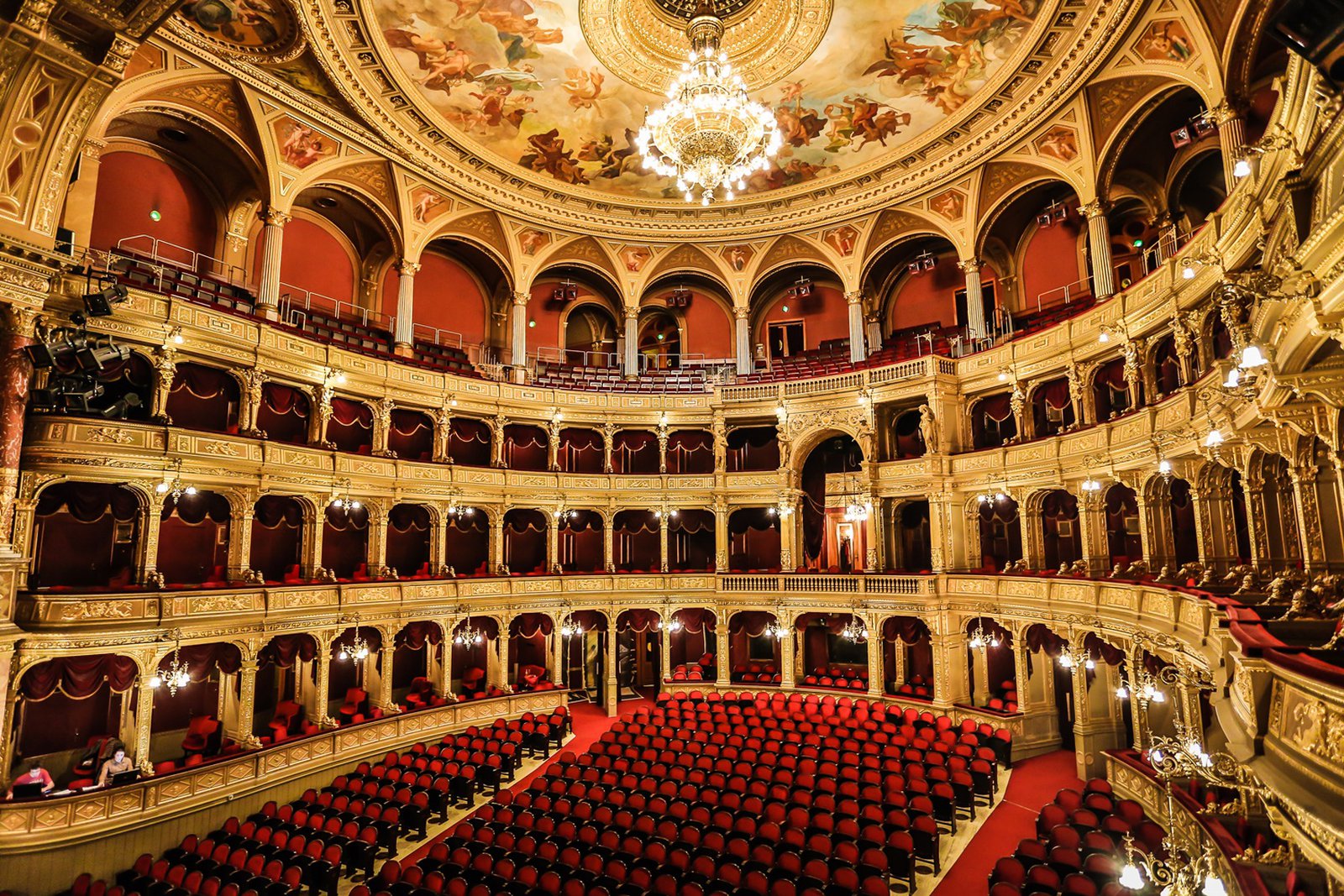
The Opera House is not only one of the most significant art relic of Budapest, but the symbol of the Hungarian operatic tradition of more than three hundred years as well. The long-awaited moment in Hungarian opera life arrived on September 27, 1884, when, in the presence of Franz Joseph I. the Opera House was opened amid great pomp and ceremony. The event, however, erupted into a small scandal - the curious crowd broke into the entrance hall and overran the security guards in order to catch a glimpse of the splendid Palace on Sugar út. Designed by Mikós Ybl, a major figure of 19th century Hungarian architecture, the construction lived up to the highest expectations. Ornamentation included paintings and sculptures by leading figures of Hungarian art of the time: Károly Lotz, Bertalan Székely, Mór Than and Alajos Stróbl. The great bronze chandelier from Mainz and the stage machinery moda by the Asphaleia company of Vienna were both considered as cutting-edge technology at that time.
Many important artists were guests here including Gustav Mahler, the composer who was director in Budapest from 1887 to 1891. He founded the international prestige of the institution, performing Wagner operas as well as Magcagni’ Cavalleria Rusticana. The Hungarian State Opera has always maintained high professional standards, inviting international stars like Renée Fleming, Cecilia Bartoli, Monserrat Caballé, Placido Domingo, Luciano Pavarotti, José Cura, Thomas Hampson and Juan Diego Flórez to perform on its stage. The Hungarian cast include outstanding and renowed artists like Éva Marton, Ilona Tokody, Andrea Rost, Dénes Gulyás, Attila Fekete and Gábor Bretz.
© Berecz Valter

Related events